- WhatsApp: +8615800837670
- EMAIL: info@kacexpo.com

When people mention Georgia, wine, snow-capped mountains, or its key role in the Belt and Road Initiative often come to mind. Yet on the map of the global apparel supply chain, this small Caucasus country is emerging as a high-profile “sewing machine”, thanks to its unique policy advantages and strategic location.
From Nike and Adidas to Zara, “Made in Georgia” is appearing more and more often on the labels of these familiar international brands. Today, we go beyond Georgia’s manufacturing cost advantages to explore a core question: does it only handle cutting, making and trimming, or can it also weave and produce fabrics? And where are the opportunities for Chinese fabric suppliers?
Why Georgia? It’s Not Just About Low Costs

Located in the Caucasus region of Eurasia, at the crossroads of Western Asia and Eastern Europe, Georgia borders the Black Sea to the west and boasts an extremely important strategic position. Its capital Tbilisi serves as a regional transport hub. With this geographic advantage, Georgia has become a natural bridge connecting Europe and Asia.
More importantly, it offers a first-class business environment:
- Extensive Free Trade Agreement (FTA) network: Georgia has signed the Deep and Comprehensive Free Trade Area (DCFTA) with the EU, as well as FTAs with Türkiye, China (including Hong Kong), Ukraine, the European Free Trade Association (EFTA) and CIS countries. It also benefits from Generalized System of Preferences (GSP) treatment from the United States, Canada, Japan and other countries. This means products manufactured in Georgia can enter a huge market of around 900 million people duty-free or at preferential tariff rates.
- Favorable tax policies: Georgia applies a transparent, low-tax system, taxing only distributed profits while exempting retained and reinvested profits. Export-oriented manufacturers in free industrial zones (FIZs) in Poti, Kutaisi and Tbilisi enjoy exemptions from almost all taxes except personal income tax.
- Low utility costs: Industrial electricity costs as low as approximately 6 US cents per kWh, with 80% coming from hydropower – clean and affordable.
- Young, skilled and cost-competitive labor force: The average monthly manufacturing wage is around US$370 (as of 2018), labor laws are flexible, and the government supports vocational education and customized training. In addition, Georgia’s banking services are convenient and efficient, with widespread online and mobile banking, greatly facilitating cross-border remote management.
These advantages have attracted numerous international brands to set up production facilities here, including Marks & Spencer, Moncler, Nike, Adidas, Zara, Puma, H&M, Tommy Hilfiger, Koton and Next.
A Hidden Weakness: It Makes Clothes, But Hardly Woven Fabrics
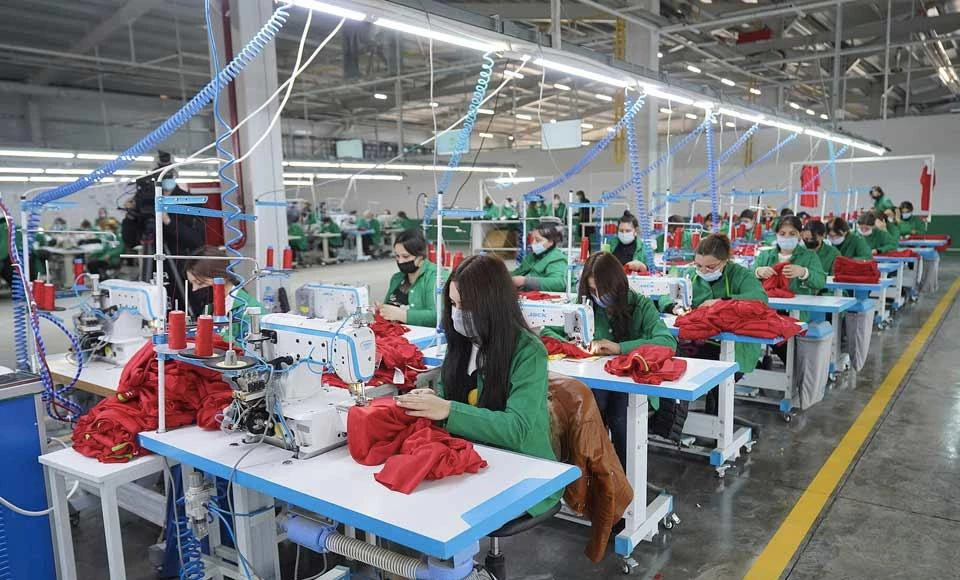
Behind the impressive contract manufacturing figures, however, Georgia’s textile industry has an Achilles’ heel: it produces almost no fabrics domestically.
Although Georgia has a long manufacturing tradition dating back to the 1960s and 1970s, its modern textile industry chain suffers from a clear structural gap. Industry data shows that Georgia has virtually no large-scale local textile production capacity. Even its so-called “sustainable fashion” brands rely heavily on imported raw materials.
This creates a distinctive scenario: Georgia’s factories hum with activity, with workers proficiently performing cutting, manufacturing and trimming (CMT) operations, yet nearly all the fabrics they process come from abroad.
The Fabric Supply Lifeline: Türkiye First, China Second
If Georgia does not produce its own fabrics, where do they come from? The answer is imports, highly concentrated in just a few sources.
For key raw materials such as cotton, Georgia’s import structure is clearly defined:
- Türkiye (over 65%): Thanks to its geographic proximity and free trade agreements, Türkiye is the “main artery” feeding Georgia’s textile industry.
- China (around 18%): As a global textile powerhouse, China plays an indispensable role in supplying fabrics to Georgia. Especially in recent years, with the advancement of the Middle Corridor initiative, logistics channels for Chinese fabrics to reach Georgia have become smoother.
Notably, major manufacturers such as Ajara Textile, which produces for Nike and Adidas, depend heavily on imported raw materials. To meet the EU’s rules of origin for diagonal cumulation, some raw materials must even come from Türkiye or Georgia itself, further deepening ties with Türkiye.
China’s Opportunities: More Than Fabric Sales, but Industrial Chain Complementation

For Chinese textile enterprises, Georgia’s fabric gap represents enormous potential.
First, direct fabric trade.
2023 data shows that China has become the leading supplier of certain knitted fabric categories to Georgia, even surpassing Türkiye. From functional chemical fiber fabrics to knitted cloth, Chinese companies can fully leverage Georgia’s tariff advantages by exporting fabrics to the country for garment processing, with finished products then sold to the EU duty-free.
Second, upgrading industrial capacity cooperation.
Georgia not only needs fabrics but also lacks high-value-added sectors such as printing, dyeing and finishing. International trade fairs held in Tbilisi, which bring together fabric suppliers from Türkiye, China, the UAE and elsewhere, reflect strong local demand from designers and manufacturers for high-quality textiles.
Connecting with China: Where Is Our Fabric Backbone?
For businesses looking to engage in apparel contract manufacturing or invest in fabric plants in Georgia, which industrial clusters in China can provide strong support?
China has the world’s most complete textile industry clusters. Given Georgia’s focus on manufacturing sportswear, fast fashion (Zara) and high-performance outerwear (Moncler), the following regions are particularly noteworthy:
- Shishi & Jinjiang, Fujian (casual and sportswear): Shishi is a hub for casual apparel, while Jinjiang is a core production base for raw and auxiliary materials for sports shoes and apparel. It is the main supply base for brands like Nike and Adidas, offering mature sportswear fabrics and accessories.
- Haining & Zhuji, Zhejiang (warp knitting & chemical fibers): Haining excels in warp-knitted composite materials, and Zhuji in intelligent embroidery machinery, providing technical advantages for functional garments and specially processed fabrics.
- Hanchuan, Hubei (sewing threads): Auxiliary materials should not be overlooked. Hanchuan produces two-thirds of China’s sewing threads, a key component determining finished garment quality.
- Wujiang, Jiangsu (imitation silk & chemical fibers): A major center for imitation silk fiber materials, Wujiang boasts strong R&D and production capabilities for fast-fashion women’s wear fabrics.
- Changzhou, Jiangsu (specialty fabrics & dyeing): One of the birthplaces of modern China’s textile industry, Changzhou has formed a full industrial chain covering spinning, weaving, dyeing and finishing, apparel and textile machinery manufacturing. Its specialty products include yarn-dyed fabrics, corduroy and denim, supported by industrial clusters such as Hutang, known as a “Famous Textile Town of China”.
Conclusion
Georgia’s apparel manufacturing sector is like a high-performance sewing machine – yet it lacks the “fabric” – the domestic textile production that feeds the machine.. For Chinese companies, Georgia represents both a promising market for high-end fabric exports and a strategic gateway to avoid trade barriers and access the European market.
When “Chinese fabrics” meet “Georgian manufacturing”, with onward access to the EU market, a brand-new “golden corridor” in the supply chain is quietly taking shape.

2026 Smart Life Expo Georgia
Dates: September 26–28, 2026
Venue: Tbilisi
Frequency: Annual